Tag Archives: Chilcotin

Chilcotin, British Columbia

First Shopping Trip of the Year

No one can remember such a mild winter.  The weather is more like late April than early February.  The river has large chunks of open water.

1 river opening

And there is bare ground on all the sunny slopes.

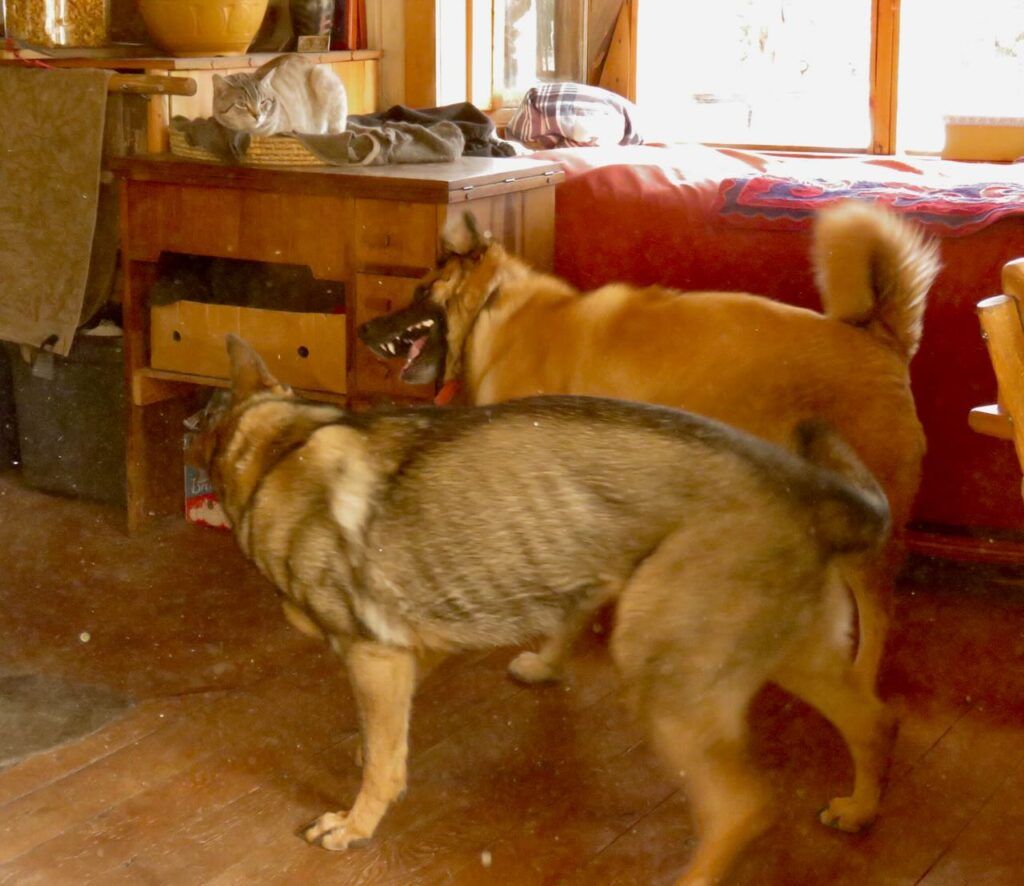
Harry and Badger

So it was quite a surprise when I ran into wintry driving conditions going to Williams lake on the 14th February for the first shopping trip of the year.

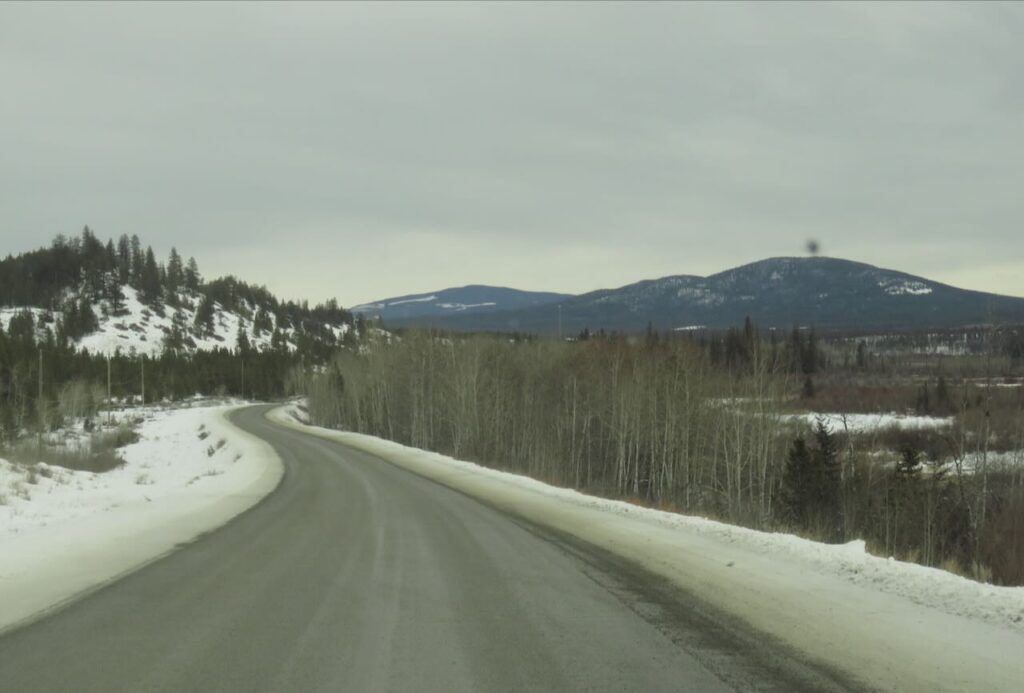
Highway 20 winter

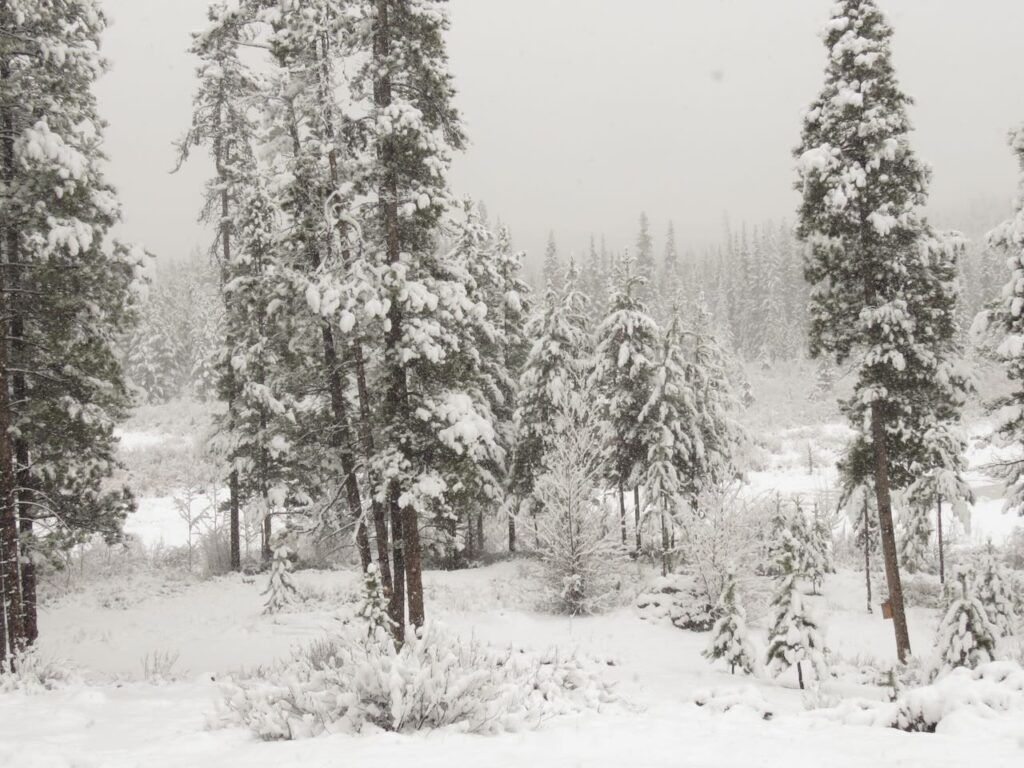
it wasn’t so bad when I left home in the dark, minus 3 C with an occasional flake, but soon I ran into 3″ snow on the road and -8C temps.  Snowflakes whirled thickly in the headlights but at the same time it must have been raining because ice was building up on the windshield.  We’ve had such a soft winter I was not prepared for those conditions!

Towards Williams Lake, the weather cleared a bit.  The road is full of logging trucks at this time of year.  What matchsticks the Chilcotin produces!  When I first came to the area 30 years ago, Chilcotin timber was considered worthless.  Now they cannot cut it down fast enough.

Chilcotin logging trucks

I spent the night at 108 Mile but did not have time to visit Walker Valley as I needed to be back in Williams Lake by 8.00am for a van service.  While there, the temperature rose and the sun came out.  Another coatless day.

carpark, Staples

I took this picture because of the bird on top of the pickup.  Isn’t he a fine fellow.

raven

I was able to leave town by early afternoon.  To avoid falling asleep on these long, driving/shopping trips, I often pick up a coffee at Lee’s corner, the first stop along the Chilcotin.  (I never drink coffee at any other time.)  I enjoyed their notice board.

Lee's Corner notice board.

Lee was a man who thought he could make money out of the Yukon gold rush.  He decided he would make his fortune, not by grubbing for gold, but by driving cows from the southern ranchlands to the goldfields.  The lack of feed and rough terrain defeated him.  The last cow died here.

It was cloudy again when I left Williams Lake but all along I could see a strip of blue sky in the west. (This large burn happened in 2003.)

Tatla lake environs

The edge of the cloud was quite dramatic.  I got sunshine all the rest of the way home.

9a edge of cloud

On the Tuesday before I left, Bill the plumber came to finally fit my reverse osmosis filter.  I bought the thing last November, and Bill has been promising to fit it since the New Year.

Bill the plumber

Of course, he found he was missing an adapter.  The under-sink pipes that he put in were the wrong size.  He was on his way to Williams Lake: he would be returning the day I left.  I looked forward to having drinking water when I got home.  I have been hauling water ever since I bought Ginty Creek nearly 7 years ago.

There was a nice new tap in my sink.  But nothing came out of it.  Bill could not find the right adapter in Williams Lake.  He should get it within a day or two.  He might be by to fix it in two or three weeks.  (It is not covered by warrenty unless it is fitted by a plumber.)

Such is life in the Chilcotin.


A Run to Anahim Lake

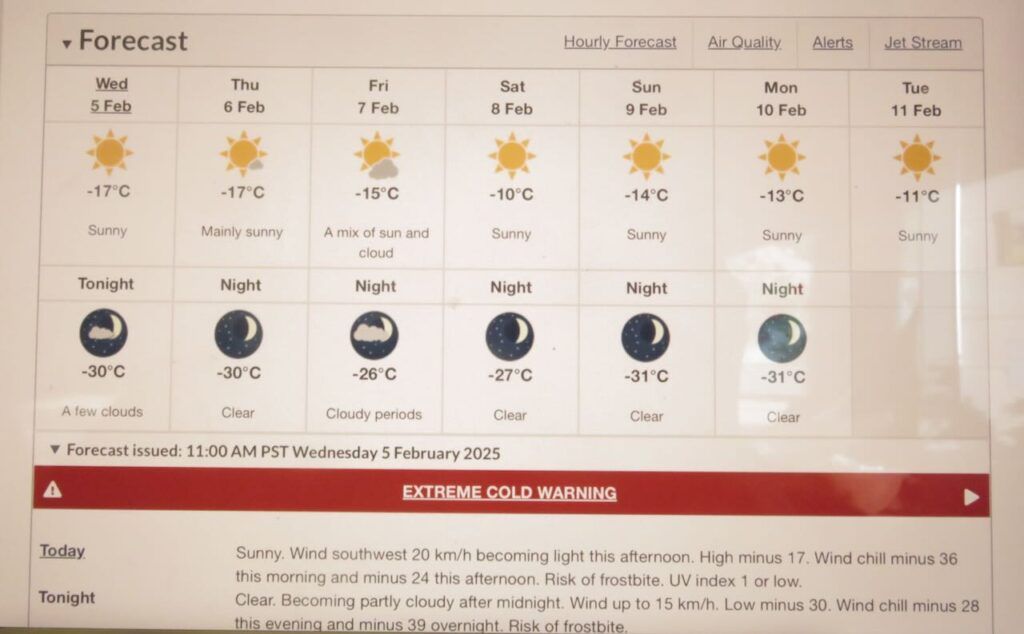
The road was ploughed just in time.  I was down to my last handful of dogfood; also, I was just about out of drinking water.  The well supply is too salty and sulphury for plain drinking so I bought a reverse osmosis filter, but things never happen fast on the Chilcotin so it is not hooked up yet.  Lack of drinking water is not too serious now as there is enough snow to shovel and melt, but it is certainly easier to collect it in cans.

It was another -30C morning so I had to wait a little for my van to warm up (it is not possible to plug it in on a solar power system unless I run the generator, and that would have had to be brought in to warm up first…..)

A trip anywhere means you do half a dozen different things.  As well as water and dogfood, I wanted to pick up mail and go to the dump.  At the dump there were three bald eagles in attendance; two adults in full plumage,

mature bald eagle

And one very large immature (must have been a female as they are bigger than males.)

immature bald eagle

The Chilcotin is famous for its fences.  Here are three examples that don’t need posts.  The Russel fence is common across Canada.  It is supported on tripods, and both the tripods and rails are tied together with wire.

russel fence

A very common one is the snake fence.  It is the easiest to build but takes more trees and uses more space.  Sometimes the top rail is wired.  It can easily be taken apart to drive livestock through – that was both an advantage and disadvantage; when cattle drives were common, people would “borrow” grazing for the night when they were passing through.

snake fence

The third type is known as horse and rider and I believe it was invented on the Chilcotin.  It generally uses thinner poles.

horse and rider

I never buy factory meat or eggs.  So I called in at a friends.’  His place is a bit rough and ready but it is very “Chilcotin”.  But the important thing as far as I am concerned is that his chickens are very happy.

egg farmer

To comment on this post, please click on the title and scroll down to the bottom of the page.

Going Home!

It was pouring when I left the Lower Mainland.

The high mountain highway I had used on the way south had been closed for several hours due to heavy snow the day before, and more snow was forecast.  So although the digital info signs said the road was open (with slippery and slushy sections)  I elected to follow the Fraser River up the canyon.

I stopped at Boston Bar for gas.

As so often happens, once I had crossed the mountains the weather perked right up.

I wanted to go to Vernon so at Spences Bridges I took a minor road to Merrit.  It was narrow and twisty, faithfully following the convoluted turns of the Nicola River.  It was also beautifully sunny.  These sagebrush and rabbit bush grasslands are what passes for a desert in Canada.

Although I had avoided the Coquihalla, I still had another high mountain pass to go over, but it was no problem.

The following day, travelling through Kamloops was gorgeous.

Then at last, the junction with Hwy 24….

I stayed overnight at 108 Mile House, and the following morning had most peculiar weather.  I left in snow-splotched rain with the temperature +3C.  Soon it was sleeting thickly.

All of a sudden, the road was white and the temperature was -2C.  I slowed right down figuring it was probably very slick, and on top of a rise there was a pickup truck completely upside down right on the pavement.  Several people were standing around and there did not appear to be anyone in the cab so I assumed everyone was OK.  But as I continued I was met by a number of wailing vehicles: police, ambulances, firetrucks, rescue trucks.  I can only assume that there must have been another vehicle involved that had gone off the road with much more serious consequences.

And now it was snowing a real blizzard – and the temperature was -6C.  At least the surface of the road was now less slippery.  Shopping in Williams Lake was miserable.  But as soon as I climbed out of the river valley, I broke through the clouds – and the temperature was +4C.  There had been a cold front across northern BC, but a small tongue of chilled air must have pushed down along the Fraser river.  At the higher altitude on the Chilcotin, one might have been on a different planet.

Shortly before I arrived home, the snow was more evident.

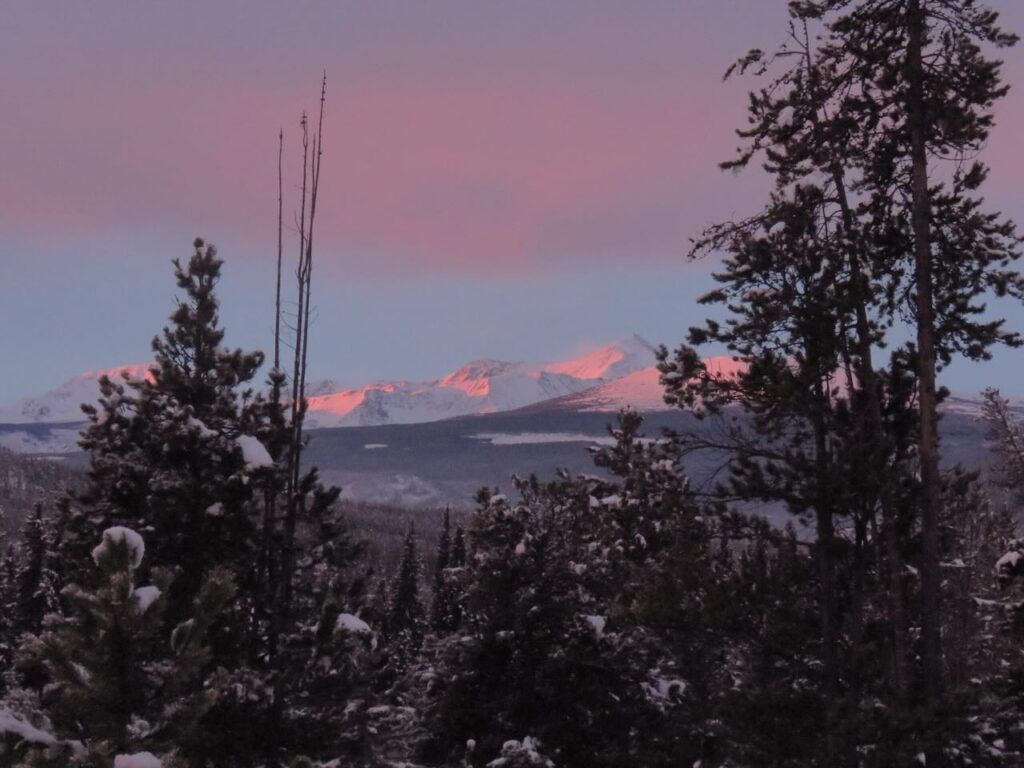
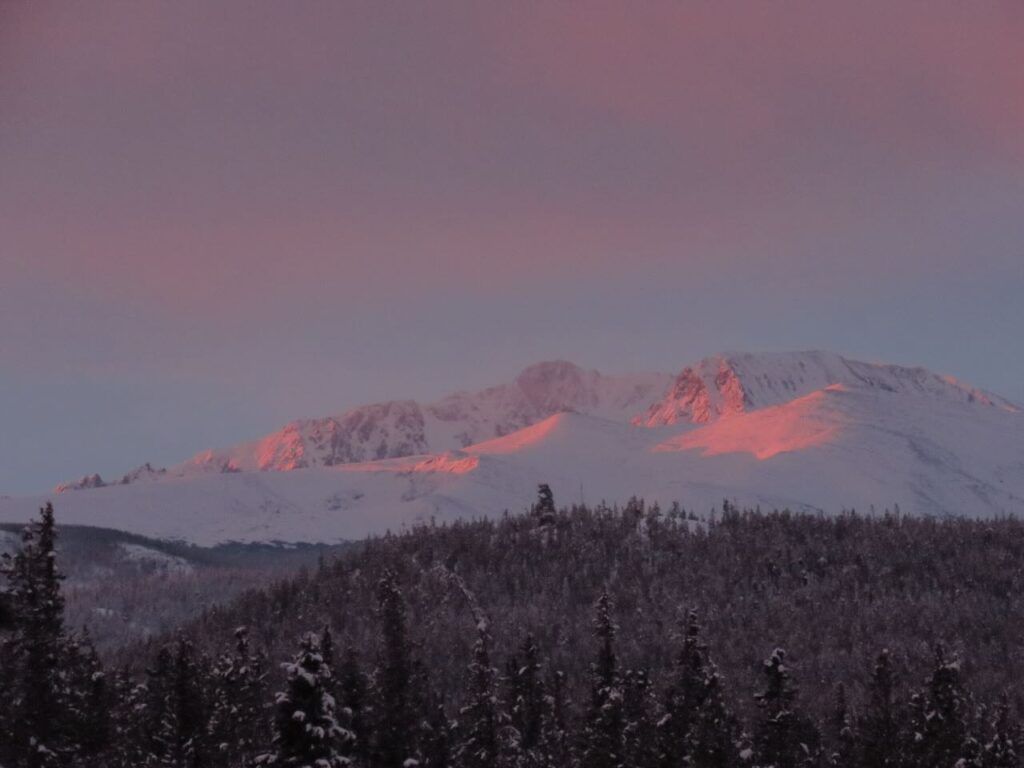
That is Noghwhon, one of the mountains I see from my window.

The dogs and the two volunteers were pleased to see me.  How lovely to come home to a warm cabin and supper already cooked!

On the whole it was a good book tour.  I had great audiences – thank you everyone who managed to come – met a lot of old friends and made new ones.  But it is exhausting being on the road for all that time.  Everywhere is so busy and noisy. At Ginty Creek it is gloriously quiet.  And at night I cannot see one human light.

The volunteers who looked after Ginty Creek got a ride to Williams Lake today, and I am, after many many weeks, finally alone.

Chilcotin fall

The fall colours are developing rapidly.  The grass has bleached almost white.

The leaves are developing a tapestry look

A heron has been visiting the pond most afternoons

The evening light is rich along the wetlands

The aspen leaves are full of texture

The morning before it rained, we had a brief spear of sunlight

When I took the volunteers to town, it was the second rainy morning.  But only in small patches: I left home in the dark and as the sun rose, there were some fantastic fog effects.

Coming home in the afternoon the Chilcotin was ablaze

The graveyard on the Redstone reserve made interesting caligraphy with the yellow leaves

This was near Tatla Lake

As well as taking the volunteers to town, and the wobbly van to the garage, I also took Badger to the vet.  He had a stick wedged in his mouth: he had been biting at the woodpile where the packrats lived.  When he pawed at his mouth afterwards, I could not see anything.  That evening he was back to normal, eating crunchy food etc, and I thought that maybe he had bitten a wasp.  But one day I saw an infection in a line right across the top of his mouth.  Apparently this is not uncommon with dogs who bite at sticks.

Badger had to be sedated and even after we got home, he was totally spaced out.

I am pleased to say he is feeling fine this morning, though!


The turn of the seasons at Ginty Creek

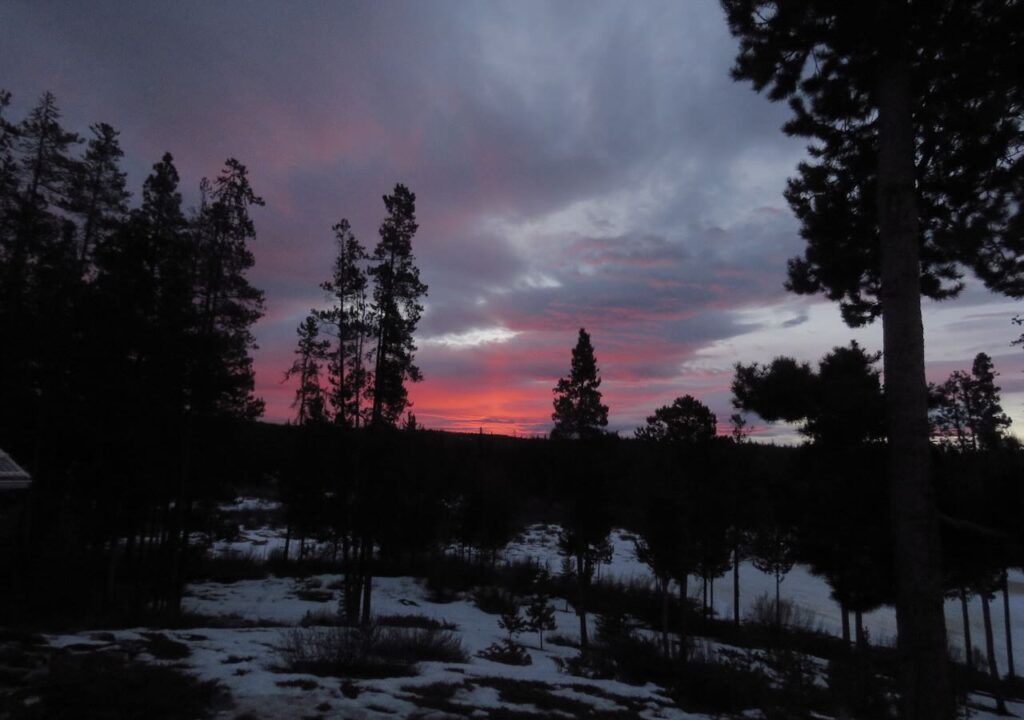
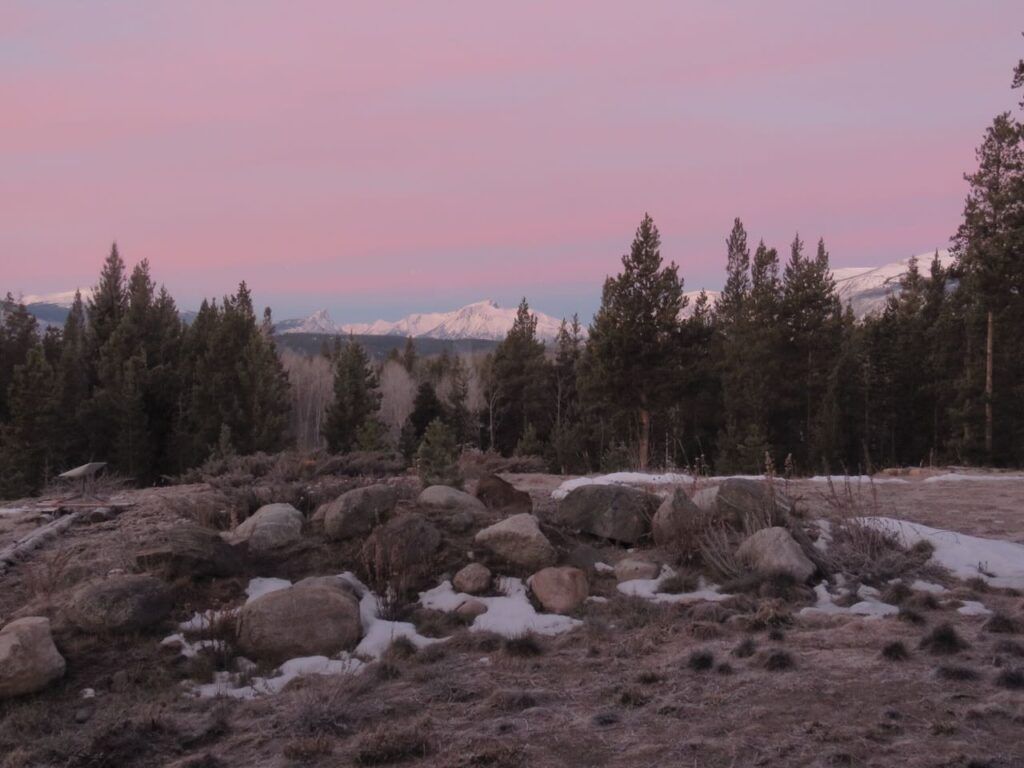
The weather for the most part has been amazingly hot and sunny.  However, it is usually a few degrees below freezing by the time the sun rises, and there is a definite hint of fall in the air.  The sunrises are endlessly pink

The van saga is still not resolved.  Having spent several thousand dollars with one guy, who pronounced it drivable, but I still was not happy with it, I took it to another who told me his mechanic was scared to drive it and contradicted almost everything the first guy said.  He told me repairs would cost 2,000 more and the parts would take 2 weeks to arrive.  So I drove the shaky van home with a load of stuff, but first spent the night at 108 where I took my usual early morning stroll around the Walker Valley.  The leaves there had a definite yellow cast.

As the sun rose, ducks floated on the misty pond.

Coming home, the Chilcotin was brilliant.

Further west a cattail swamp was turning yellow.

Because of the long hot summer (way more heat and sun than usual), the range feed is eaten down and a lot of the cows are wandering home, mostly on the highway.  One has to drive extremely carefully at night.  Some cows are more goofy-looking than others.

Then the weather suddenly turned cold and rainy, just as I took the volunteers down to Bella Coola to see the bears (except there weren’t any – they come for the rotting salmon and there are hardly any fish in the river this year as the spawn got washed out to sea in the big flood 2 years ago.)

Now it’s back to +27C temps in the day and -2 or -3C at night with endless sunshine forecast.  One morning, there was an acrid smell of smoke.

The fire was north of Anahim, above Moose Lake.  There was no natural reason for the fire – not a hint of lightning – and it was close to some cabins so there was either extreme carelessness or something fishy going on.  (This photo was by Johnny Blackwell.)


Drilling The Well at Ginty Creek Part One

Good water is hard to find in the Chilcotin.  Shallow wells taste swampy and deep ones are full of iron or sulphur, or, in some cases, arsenic.  Ginty Creek did not come with a potable water supply.  The river runs at the bottom of the two properties, but it needs to be boiled to be drunk, is brown for half the year, is too difficult to get in the winter, and it is almost a kilometre from the house.  The creek often dries up in summer and even when boiled for half an hour, tastes of pure swamp.  My main desire, when I had the money after selling Nuk Tessli, was to have a well drilled.

This is a major gamble.  Friends spent $21,000 and did not get a scrap of water; I heard of another well that cost $30,000 with no result.  Another man had to drill to 650 feet – another $30,000 well, but he at least had plenty of water.  The tow truck driver who took me to town recently, had a 60-foot well that had beautiful water – for a month.  Then is started going rusty and was soon pure orange.  He ran some into a holding tank to see if it would settle but it fermented and was worse than ever.  His cows got sick drinking it.  Across the road, another man drilled 200 feet and got 75 gallons a minute, enough to supply a small town.

Christine Peters (author of The Lure of the Chilcotin) had a well drilled 3 years ago.  Most of it was through bedrock.  She was going to cut off at $20,000.  They had reached 400 feet.  But the drillers kept going another 90 feet for free and she got 2 cups a minute.  At first, it was full of arsenic, but gradually this has dissipated.  She came along to Ginty Creek watch the show.

The drillers tell us that some witched wells produce water and others do not.  Even if they can witch themselves, they refuse to take responsibility for the choice of site.  I seemed to be able to witch.  I heard that you could use straightened coat hangers: I had no coat hangers (which says something for the state of my wardrobe) but the telegraph line used to run through my property and the previous owner made fences of it.  Much is now lying around in huge tangles.  So I broke of a couple of lengths, bend one end of each for a handle, and held them in front of me like a film star cowboy having a shoot-out at high noon.  When water is registered, the rods swing across the witcher’s body.  A good supply makes them touch the witcher’s shoulders.

Before I went to Nuk Tessli, a rep from the drilling company, JR Drilling Central  (based in Kamloops: no Williams Lake company wanted to be bothered coming out west: they can make much more money with industrial drilling, so we were lucky that JR Drilling would come) came to look at my site, and that of several other local people who also wanted wells.  Most of these were summer people so not around, and I drove with the rep (who happened to be the owner) to look at the sites.  There had to be room for two large, heavy  trucks to park near each other; in many cases trees would have to be fallen and stumps cut out of the way.

At one site, the ground would also have to be levelled.  So we looked at a less destructive location for the absent owner.  I started witching with my rods.  Don, the owner, could not resist trying as well – he got much the same results as I did.  The neighbour saw us and came to chat: she said you could witch with an egg.  She went and fetched one.  You hold the egg on your palm: when there was water, it stood on end.  So there we were, walking up and down watching an egg on our palms.  Don said it twitched for him: it did nothing at all for me!

The morning after I got back from town with my van, the well-drillers arrived.  I had witched a site quite close to the house.

The signal was not all that strong, but there seemed to be nothing better in the area.  For many years I have used a pendulum for various health matters – mainly food sensitivities - and I wondered if the pendulum could tell me the depth.  The pendulum gives yes/no/maybe answers.  I asked if there was enough water more than 100 feet down: No.  More than 50 feet? Yes.  In that way I determined it was 60 feet down, which was good news.

While Jerry was setting up the drill, Dean was unloading the drill sections and the casings.

They were married to the carriage (I do not know the technical term of this part of the drill tower, but it seems appropriate)

Then lifted into place.

The bit was positioned exactly over my witched mark.

The Chilcotin is largely volcanic with a thick layer of glacial tilth on top.  It was a no-brainer that the first part of the well would go through silt, sand or gravel.  Thar she blows!

Because of the loose material, each section had to be cased.  Within minutes, the first 20-foot section was in the ground and the second casing was positioned and welded on.

Bentonite was poured into the hole.  This swells and seals the well so that surface water cannot run in and contaminate it.

If I interpreted the pendulum correctly, I would need only 3 sections.  But when the third casing was put together, Dean was already unloading more sections.  He obviously had no faith in my efforts!

And we did get water at around the depth I had predicted.  But it was totally mixed with fine soil and there was no way it would make a well.  It came out of the discharge pipe in clumps.

Was this what the witching rods had depicted?  Would there be any more if we went deeper? Then Christine Peters and I got very excited because water began to pour out.

But it was a false alarm.  The drillers were having to pump water in to keep the drill from clogging up!

Four or five hours had now gone by.  The well was a hundred feet deep.  Things started to go very slowly.  A sample was taken – using a very high-tech tool: a kitchen sieve clamped on to the end of a pole.

Jerry announced we had hit bedrock.

A Walk around the Wetlands at Ginty Creek

I snatched an hour to walk around the wetlands.  What luxury it will be next year to enjoy this kind of activity without feeling guilty.

It has been very cold and rainy again so the spring has slowed down a bit.  The textures in the wetlands are beautiful.

I have called this next picture “So Chilcotin.”  Those of you who are familiar with  the area will know exactly what I mean.

In one part of the wetland are small dead trees covered with red lichen.

I don’t know of anywhere else where this particular lichen grows.  Here is a closeup

In another part of the wetland I found a gorgeous insect.  It is quite large – the body is as long as a finger joint.  It is obviously some kind of grasshopper relative.  I have found them occasionally before, even above the treeline, but usually in a hole under a rock.  I have never seen one with wings before.  They always seem very sluggish.

On a more prosaic front, I have been drying organic kale.  It dries very easily and makes great healthy food for camping or for areas far from stores.  I can buy this at Anahim Lake – but only if I buy a whole case as no one else in the area would want to eat it.  This makes a lot of kale to deal with!

I thought it looked quite pretty on the screen.

Martin Weinhold

A friend told me that a German photographer, Martin Weinhold, was looking for subjects for his Workspace Canada project.  He had portrayed a number of city occupations and was interested in the kind of activities that go on in the west Chilcotin – ranchers, outfitters, pilots, general storekeepers etc.  I went round with him on his first day to introduce him to people.  It happened to be one of the three days a week that the sched flight from Vancouver arrived at the Anahim Airport, and I watched him setting up his camera.

airport at Anahim LakeHere is Martin checking Kim, the woman who runs the office, with a light metre.

checking Kim with the light metreIt was a sunny day, but with a cold wind…..

windsock at Anahim lakeWhile we waited for the plane (which was late) I amused myself with my digital snapshot camera.  I don’t think the search and rescue van has been moved for years.

search and rescue van at Anahim LakeI enjoyed these introduced weeds and their shadows on an old oil drum

oil drum at Anahim LakeThen I got close up to a dandelion

dandelion at Anahim LakeAnd next I did my big zoom thing with some foxtail barley grass.

barley grass at Anahim Lake

.

Heatwave at Ginty Creek

As a contrast to the appallingly wet winter, spring and summer, we have finally had a heatwave.  The temperature has been cool in the morning – sometimes freezing – and 28 – 30 C in the afternoon for day after day.  We finally have our summer.

hot sunrise at Ginty CreekThe Chilcotin is bleaching in front of our eyes.  The temperature made my trip to town pretty exhausting.  On the way home I stopped for a break at the Redstone Reserve.

reserve at RedstoneThey have a curious little graveyard jammed tight against Highway 20.

graves at Redstone ReserveThis grave fence has a cross made of horseshoes.

cross made of horseshoes at Redstone ReserveBack at Ginty Creek the grasses are bleached as well. These were lit by the last rays of the evening sun.

fence at Ginty CreekThat night, we were graced by the harvest moon….

harvest moon

Busy.

I have been incredibly busy this last week or so.  After I saw the flowers in the burn, I went down to the Precipice to pick the little wild purple gooseberries that flourish down there.  They were already past their best so if I wanted any, I had to go right away.  The last time I was at the Precipice was in the spring when I went to the Cattle Drive Party. The berries are very prickly but make excellent jelly.

wild gooseberries

This was not to be a smooth-running trip, however.  I phoned my friends, Dave and Rosemary Neads, when I was about to set off from Anahim Lake.  There are no cell phone frequencies on the Chilcotin and not usually any other traffic along the 30 km of very rough road.  Normally it would take me about an hour and a half to drive it (I must go very slowly in my low van) but I told Dave and Rosemary not to worry if I was late as I would check out other likely berry patches en route.

So when I got a flat, and found that my spare was also flat, I could not expect to be rescued in a hurry.  I was about 9 km from Dave and Rosemary’s house.  Nothing for it but to walk.  I had left Anahim early afternoon and by the time I arrived they were indeed beginning to worry.  A very welcome supper was just about to be served.

Dave and Rosemary’s original home on the property was a little cabin built by the original occupier, and that is where I usually stay.  Either the builder was lazy or he was very short as I have to duck to get under the very low ceiling beams.  Outside is a struggling apple tree (the climate is borderline for apples) that bears have trashed a number of times.  Dave has rigged up an electric fence to try and protect it.

pickup and electric fence at the PrecipiceBut, as Rosemary says, any smart bear will just climb into the truck bed and get at the apples that way…..

The most economical way in terms of time and effort to deal with my tire was for Dave to plan a gas/propane/dump run the following day.  He had other business to deal with so would be gone several hours, and he figured I might as well stay down in the valley and visit Rosemary and pick more berries.  Fortunately we were able to find a tire that fitted locally (Nimpo Lake, an extra 20 minutes east of Anahim Lake) – otherwise I would have had to wait an extra day or two while one was freighted out from Williams Lake.  On his way up the hill Dave would take the wheel off the van, pick up the spare, and take both to the garage at Nimpo Lake.  He would bring the fixed wheels back to the van, put the tire on, then drive back home, pick me up and take me back to the van.  However, when he arrived home later that afternoon, it was to say that he had met another resident of the valley who had gone out to pick up some visitors.  Dave had given the van keys with him – the visitor would drive my van back down.  But then we found that the visitors were going to be delayed until late that night.  I could have stayed over another night but I had things to do…  Fortunately I had a spare key to the van.  Dave drove me back up to it, and I was able to reach home safely.  The other keys would have to languish in Anahim Lake until I paid another visit there.  All this is typical of the logistics of a wilderness dweller.

Next was a trip to Williams Lake, something I must always do soon after I fly out of Nuk Tessli.  Sometimes I do the 3+ hour drive there, shop, and drive back in the same day, but I wanted to spend time with a friend near 100 Mile.  She lives close to the Walker Valley, a precious piece of Cariboo grassland full of ponds, which is a lovely area for birds.  I like to walk there early in the morning and watch the world come awake.

walker island grasslandsThe grasslands are wonderfully lush this year, as they are on the Chilcotin.

grasslands at Walker IslandThe rising sun is backlighting this salsify seed head.

seedhead of salsifyAnd in another area there were a number of dewy spiderswebs anchored to the grasses.

spiders webIt looks a magical place from the photographs, but houses encircle the rim and all the time you can hear the roar of traffic from Highway 97.  There is a constant threat to develop this precious piece of environment out of existence.