Archive | Wild Birds

RSS feed for this section

Hummingbirds

Hummingbirds are exclusive to the Americas, North, Central and South.  (There are birds with similar habits in Africa, but they are bigger and not related.)  There are many species – the smallest weighs the same as six aspirins.  I first saw them at 16,000 feet, above the treeline, in Peru, then feeding on wild, purple-flowered fuchsia  bushes that cascaded by a mountain stream, bowed down by snow, in Chile.

Two species come to Ginty Creek, the commonest is the Rufous.

Sibleys Field Guide to Birds of Western North America

I include this page from Sibleys Field Guide to Birds of Western North America, because my photos cannot show the colouring of these amazing birds.  Sibleys can’t do the colours justice either, because they are irridescent – that is, they often look black until the sun catches them.  The best photo I have to show the irridescence is unfortunately on a specimen that was close to death – it died a few moments later.

Here is a male on a branch flexing his wings.

These birds are extraordinary in many ways.  Their wings do not behave like those of other birds because of a specialized shoulder joint.  When in flight, the wings are a blur to human eyes, but slow photography show them to move in a figure of eight, which enables the birds to hover and fly backwards – the only bird able to do this.

Their hearts beat 1000 times a minute.  They must eat every 20 minutes to survive although they can go into a sort of torpor to survive the cold nights.  They are at the feeder at very first light – often their sugar-water is frozen.

Despite their apparent tenuous hold on life, eastern species can migrate from Costa Rica to New York in FOUR DAYS!

As well as the loud hum made when they are flying, males can adjust their feathers to make a ringing buzz.  Each species has a special flight pattern when courting females.  The Rufous zooms down in a ringing kamikaze flight and whizzes back and forth over a female who is standing quietly on the ground near a bush.  The hormones are so strong, they will display to sparrows and even pine cones.

The most entertaining thing about them as far as I am concerned is the way they fight!  Eight or nine are visiting my feeder right now – sometimes all at once. (Locals tell me that once the young hatch there may be 30 birds vying for a drink but I am always in the mountains at Nuk Tessli at that time.)

They are like bees around a honey pot but with much louder buzzes. When I go and replace the feeder (which they empty within a day) they will whizz within inches of my face.


Snow

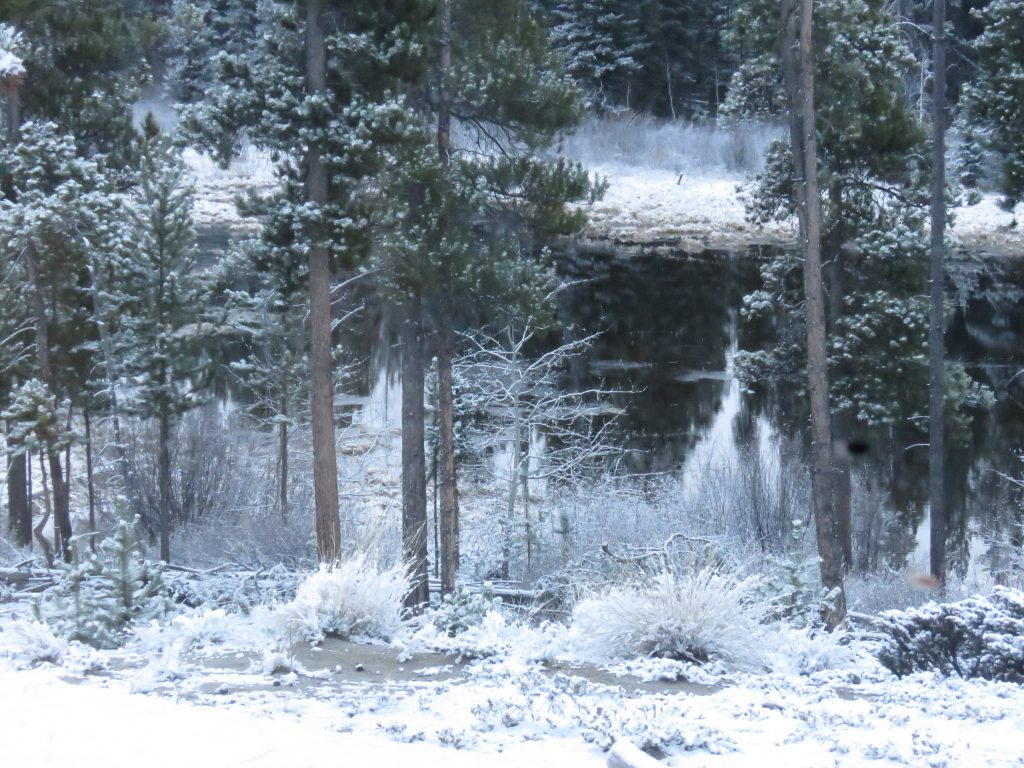
We had a little bit at first.

ice on the McClinchy RiverThe McClinchy river is quite low now.  The flow is restricted in the high country where everything is frozen so not much water gets to lower elevations.

We had one very pretty day, then it got cold.  The temperature never got below -18C, which is not at all cold for here, but these  fronts pack a nip far below the given temperature, even when there is no wind.  I have no idea why that should be so.  Day temperatures never exceeded – 12C.

I was glad of the stone stove that I built with Mogens last spring.  (Check out the posts itemized under the category “building a stone oven” on the side bar at the right.)

stone stove at Ginty CreekBecause of the chimney configuration it tends to smoke when the door is open, but otherwise it burns fine.  I use the cookstove in the morning for a faster fire, but that does not hold the heat.  So about an hour before sundown, I light the stone stove – by the time the sun has gone, the rocks are radiating heat nicely.  I cook supper on it, then give it a last feed before bed, and the cabin is toasty all night and still warm in the morning.

The birds, who had been mostly ignoring the feeder, suddenly flocked to my offerings.  Most common were the mountain and black-capped chickadees.

Mountain Chickadee

I was most surprised to see a couple of starlings.  They are the only alien birds that visit here; they usually pass through for a couple of days in the spring.  They are among a list of British birds found in Shakespeare that were introduced to New York by some misguided philanthropist.  They are not designed for colder climates.  These two were definitely out of their element.

starling at Ginty CreekAs it finally warmed up, it snowed in earnest, and we had about 6″.

snow at Ginty CreekThree grey jays, also known as camp robbers and whiskeyjacks, usurped the feeder.

whiskeyjackThe sun came out, and the snow became magical before it all got melted and blown off the trees.

It is supposed to snow a bit more before the weekend, but I hope not too much, for I wish to have a booth at the Tatla Lake Christmas craft fair.  It is also supposed to thaw so I expect I will be able to drive out without having to have the road ploughed.


Boundary Lake 21st July 2011

The following day we fought the wind and paddled up the two lakes above Nuk Tessli.  We hiked to Boundary Lake.

boundary lake july 21The flowers are all trying to bloom.  Here is a Butterwort, sometimes known as a Bog Violet although it is not related to violets at all.

butterwortButterworts are insect-eaters.  The bogs around Nuk Tessli are extremely acid.  Acidity ties up the nitrogen in the soil and the plants need to find nourishment elsewhere.  Small insects land on the sticky leaves and are unable to get away.  Enzymes in the glandular hairs that form a slimy surface to the leaves then digest them.

Another insect-eating plant en route to Boundary Lake is the long-leaved sundew.  In one bog it is extremely common.  Note the small bug stuck on one of the leaves.  Often I see dragonflies stuck there but this year no dragonflies have hatched yet.

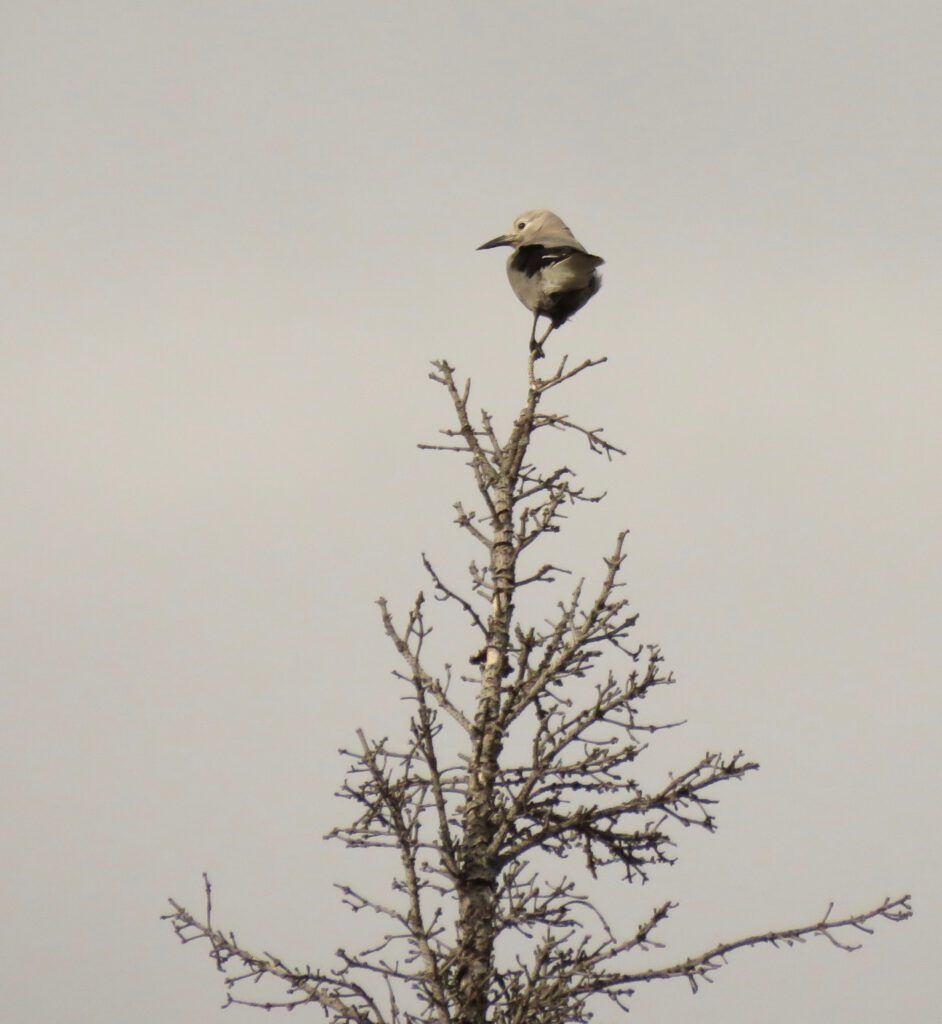
long-leaved sundewThe current clients at Nuk Tessli are birders.  The birds have rarely sung this year, but they seem to be making babies all the same.  Here is a parent clark’s nutcracker with a full-grown young begging for food.

clark's nutcrackers

Sandpipers were at last being territorial.  First the solitary

solitary sandpiper And here is the spotted sandpiper.

spotted sandpiperA bedraggled yellow-rumped warbler was collecting food for his offspring.

yellow-rumped warblerHe is looking as fed up as we are with the rain.

Cattle Drive Party Part Two

Precipice Valley

Although the Precipice is much wetter than Ginty Creek and gets a lot more snow, it is also warmer, and at cattle drive party time it is very lush.

The Precipice Valley is very lush

This year, half of it was under water.  The Hotnarko River has made a lake beside Fred and Monika’s house.

Fred's house beside the flooded Hotnarko

The valley is a fabulous place for birds, especially among the bushes close to the Hotnarko River.

Every second bird seemed to be a yellow warbler.

yellow warbler in the Precipice Valley

A rarer species was the American Redstart.  The male is black with bright orange sides.  The female is warbler-coloured.

female American redstart

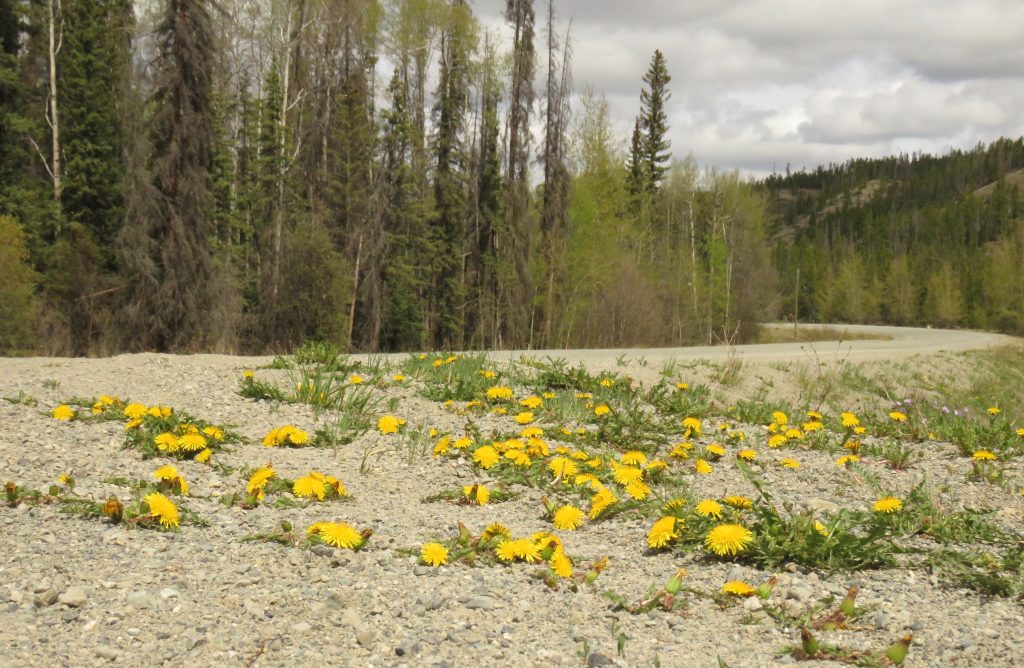
Every bit of grass was covered with dandelions and one of the insects attracted to them was the bee hawk moth.  It is smaller than the hummingbird hawk moth, but related.  They move and ook very bee-like until you get close to them.

bee hawk moths love dandelions

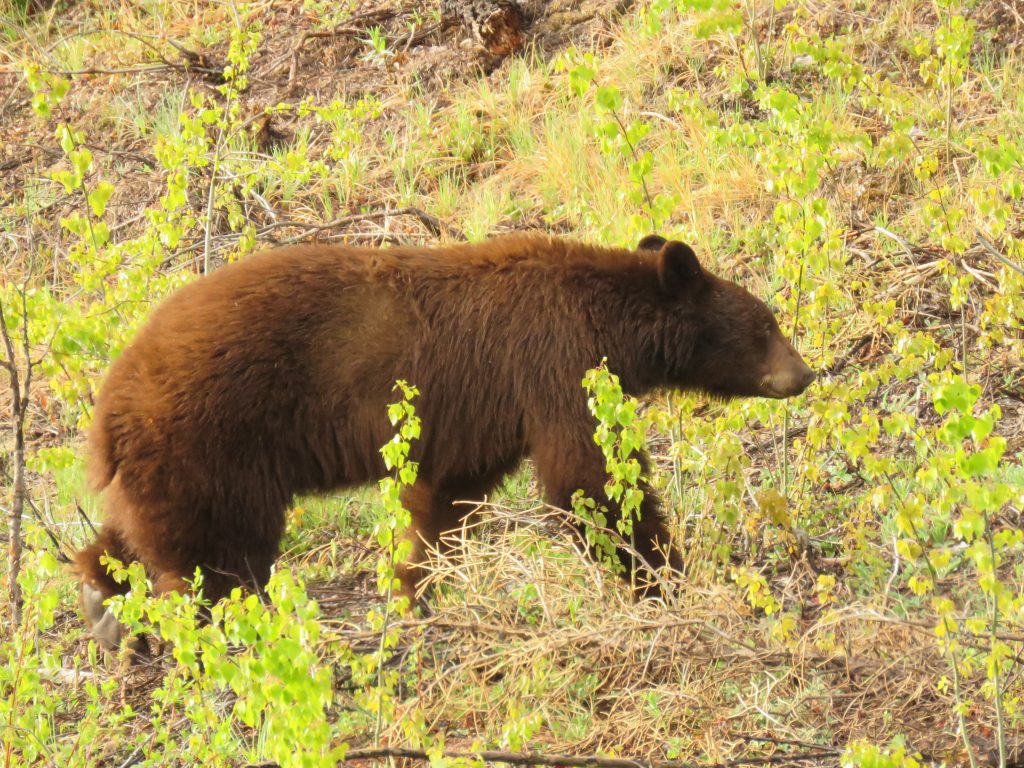
At this time of year, the Precipice Valley is crawling with bears.  Many people saw five as they travelled back and forth but I saw only this fat, happy guy on the far side of a big hay meadow.  Bears absolutely love dandelions.  As these plants are introduced, one wonders what they ate before the settlers came!

bear in the Precipice Valley


Canoeing on Nimpo Lake

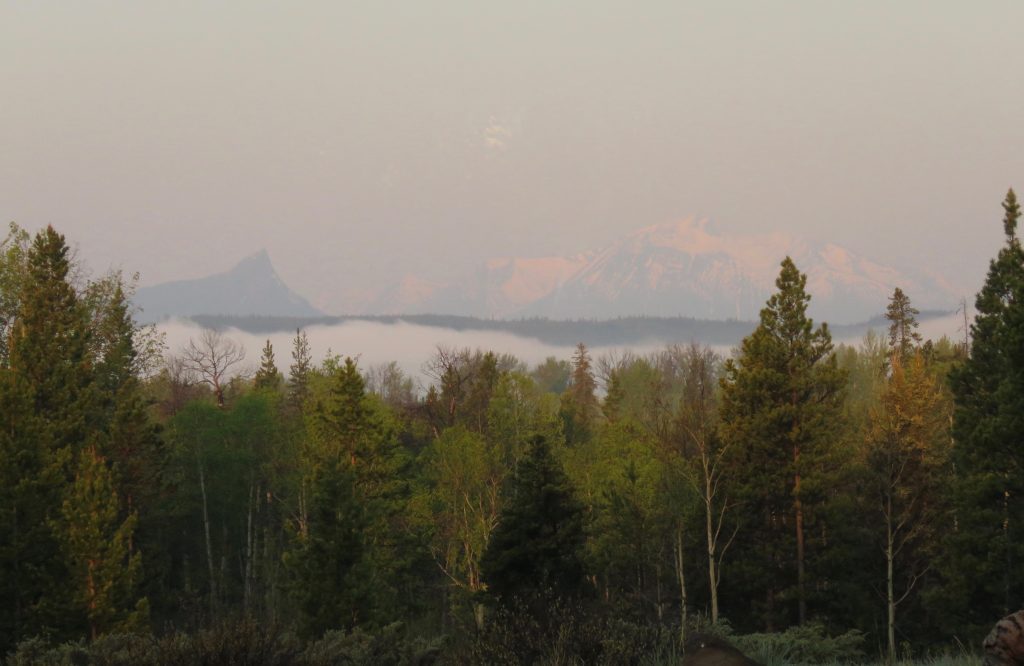
It was the first time the mountains seen from the window at Ginty Creek had been clear and pink in the sunrise for quite a while.

Finger peak seen from the window at Ginty CreekThe new summer weather was not forecast to last, so the next day we loaded the canoe onto the van and went to visit Nimpo Lake.

Nimpo Lake

The Itchas seen from Nimpo LakeThis is a view from the upper end of Nimpo Lake with the Itchas in the background.  The Itchas is one of the volcanic ranges north of Highway 20.  By this time of year usually 50% of the snow has gone from these south-facing slopes.

The ice had gone out the previous Sunday, the 15th May, the latest one resident had ever known it in over 40 years of keeping records.  It is 2 and half weeks later than normal.

Ducks on Nimpo Lake

We saw a number of ducks, mostly scoters and pintails, but several pairs of barrow’s goldeneyes

Male Barrow's Goldeneye

And there were the inevitable Loons

loon on Nimpo Lake


Rainy Day at Ginty Creek

Brownheaded Cowbirds

Bitter cold rain again.  At the feeder at Ginty Creek, brownheaded cowbirds have arrived.

The chipmunk and the cowbird tolerate each other at the feeder

They are parasitic – they lay their eggs in other birds’ nests.  The other birds must rear their enormous chicks and their own chicks are either evicted or smothered.  They are called cowbirds as they like to sit on cows’ backs (or on moose or deer) and eat the insects flushed out of the grass by the animals.  They are constantly displaying to their brown ladyfriends.  They give a thin whistle and a sort of curtsey.

brownheaded cowbird displaying at Ginty Creek.

Solar power batteries

It was too miserable to work outside, so I did some maintenance on my solar power system.  Here are the deep-cycle, 6-volt batteries that store the power from the solar panels and drive this computer.

the batteries that drive my computer

Framing a room in the basement at Ginty Creek

Then Mogens and I started framing a room in the basement.

Mogens framing a room in the basement at Ginty Creek

A Pretty Evening

It’s been cold and windy again for day after day.  Sometimes we get an hour or two of pretty weather and one day we had a lovely evening.

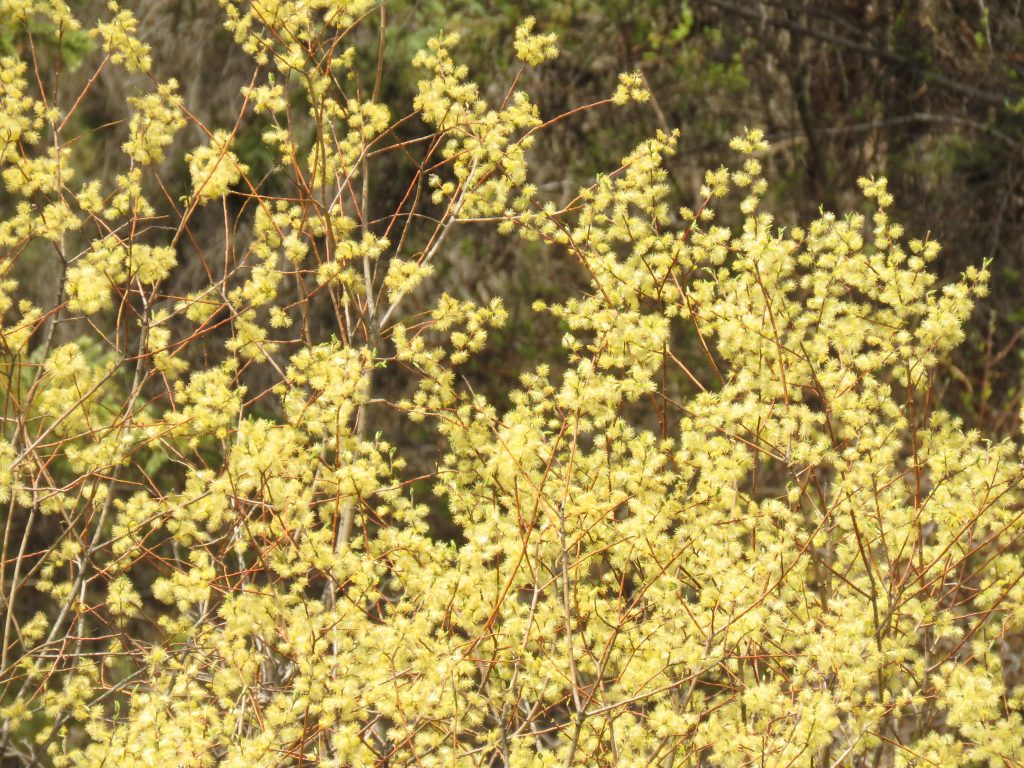
the lower pond at ginty Creek in evening lightThe pussy willows have turned yellow.

pussy willows at Ginty Creek

And this morning there was a soft, grey mist.

morning mists on the lower pond at Ginty CreekThere is a constant movement of birds.  Today two striking male yellow-headed blackbirds came to the feeder briefly.

two yellowheaded blackbirds at the feeder at Ginty Creek

It is rare to see the yellowheaded blackbirds at Ginty Creek.  I have observed them once before.  They are a bird of the open marshlands.  This immature redwing blackbird was not feeling very sure of himself.

two blackbird species at the feeder at Ginty Creek.Can’t say as I blame him!


Boardwalk

I went to Anahim Lake last Wednesday to pick up a wwoofer. I have hosted these doughty volunteer workers for a number of years.   Mogens is a wwooferMogens is from Germany and he plans to spend the summer wwoofing in Canada.  Wwoof stands for: Willing Workers On Organic Farms.  Well, I don’t have an organic farm but the organizers don’t mind.  I have had a lot of wwoofers from Germany, many also from Switzerland, some from Britain, France, Belgium, Canada, US, New Zealand, Australia, and Japan.  A few don’t work out but 90% of them are absolutely great.  Mogens seems to be enjoying the work I am giving him.

Our first job was to build a boardwalk to the upper pond.  I have always been frustrated at this time of year because I can hear all the birds landing on the newly open water but it is too difficult to get there across the flooding creek.

The new boardwalk at Ginty CreekI helped Mogens build the first part, but he finished the job himself, including the bridge part.

The next morning I could walk there dry-shod and was delighted to see a pair of American Widgeons.

An American widgeon on the Pond at Ginty Creek.

But most interesting of all were a pair of hooded mergansers. They are not common but this is the second time I have seen them at Ginty Creek.

hooded mergansers at Ginty Creek


Purple Finch

The other day I moved the bird feeder.  It was too close to the window and birds kept flying into the glass.  But I could not move it sooner because the ground was still too frozen under the surface to dig a hole for the post.  I added an attractive branch behind it to give the birds lots of different perches.

a branch behind the bird feeder at Ginty Creek

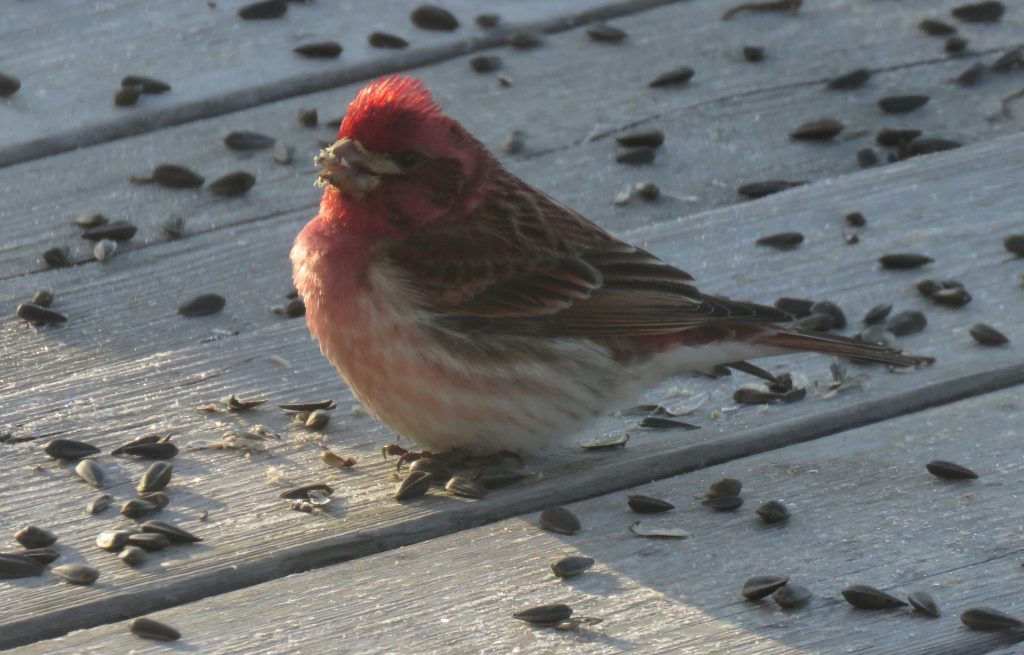
Today, this fine fellow took advantage of it.

purple finch at the feeder at Ginty CreekHe is a male Purple Finch.  His drab, stripey lady friends have been around for a while.

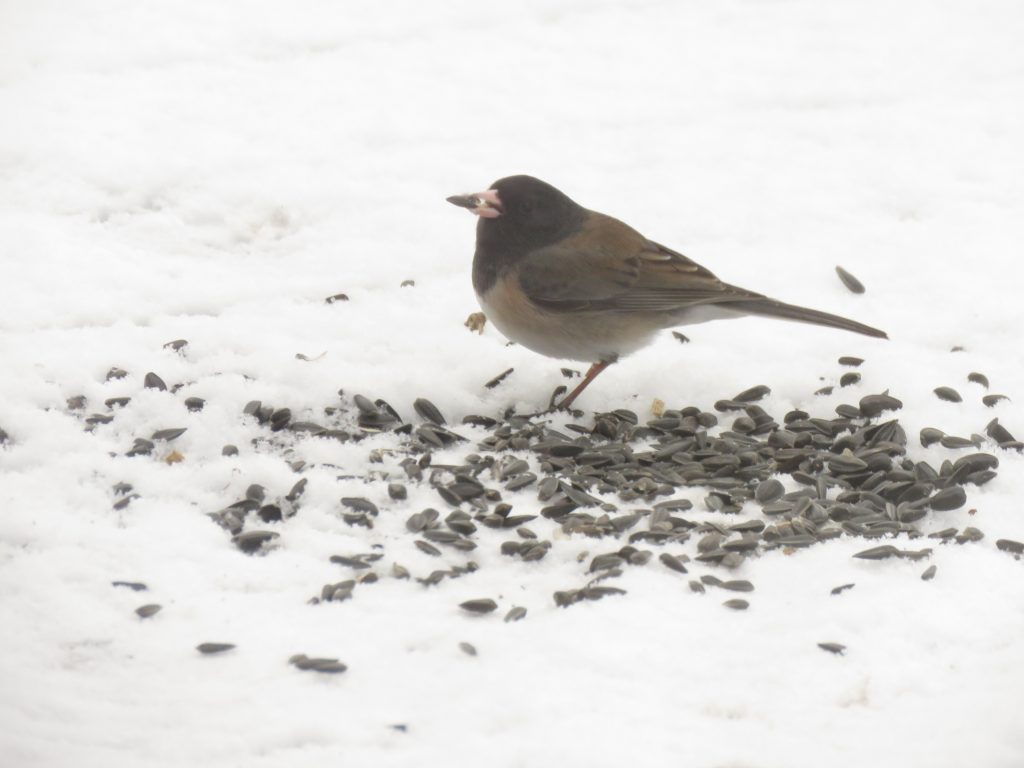
I couldn’t resist adding this cute picture of a junco.

junco at the feeder at Ginty CreekHe is not quite sure if he can dare to grab a bite of food because someone else is feeding.

chipmunk at the feeder at Ginty Creek

It was cloudy so much milder last night and the open water on the pond did not freeze over.  So first thing a pair of buffleheads were enjoying the rest stop.

buffleheads on the pond at Ginty CreekAnd there was a buzz at my kitchen window.  The first Rufous Hummingbird of the year.

male rufous hummingbird at Ginty Creek

Tardy Spring.

Storms and cold wind continue.

snow fluries over Finger Peak

It is freezing hard at night, and daily temperatures have not been above +5C for a long time.  During the January thaws they reached +9C – that temperature has not been matched since.  The forecast is for sun and much warmer weather in about 4 days’ time.  The forecast has been the same for a long time – the promised spring is always four days ahead.

Very slowly, the snow is going.  The ponds are still frozen (they were open this time last year) but the little creek has broken through the snow in the swamps.  I can hear it on the rare occasions that it is warm enough to sit on my deck.

The dogs by Ginty Creek

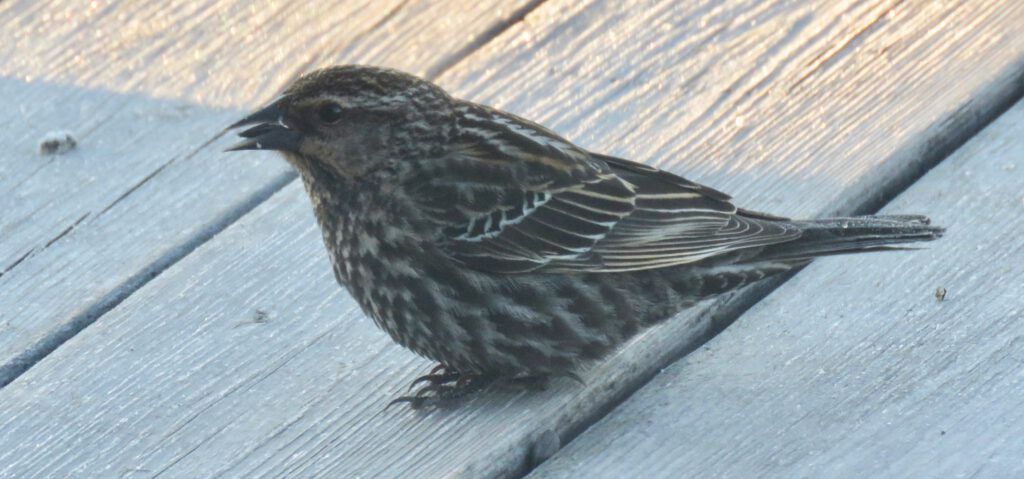
The birds are slow in coming, too.  The lady redwing blackbirds have arrived.  They look nothing like their husbands.

female redwing blackbird at Ginty Creek

This morning I had a good view of a ruffed grouse who thought I had not seen him.

ruffed grouse at Ginty CreekAnd I was charmed by a tiny scrap of life known as a ruby-crowned kinglet.  They have a noisy song, but nothing is singing in this weather.  I could not get a photo, but here is a drawing I did as an illustration for A Mountain Year.

ruby-crowned kinglet at Ginty Creek